Workshop Overview
Consider physiological responses during a stressful presentation: a racing heart, rapid shallow breathing, butterflies in the stomach. These responses happen to us. Now imagine a different scenario: you feel your heart accelerating, but your smartwatch delivers precisely timed haptic pulses that gradually slow your perceived heart rate. Your breathing steadies as thermal cues guide you toward patterns known to reduce autonomic arousal. Within minutes, the physiological cascade of anxiety begins to reverse - not through willpower alone, but through computational systems that directly engage with internal organ states.
Recent advances demonstrate the possibility of deliberately modulating such responses, for example: calming cardiac rhythms through synchronized haptic feedback, guiding respiratory patterns through thermal or vibrotactile cues, or influencing gastric interoception with haptic feedback. Each approach shows measurable effects on physiological state and subjective emotional experience.
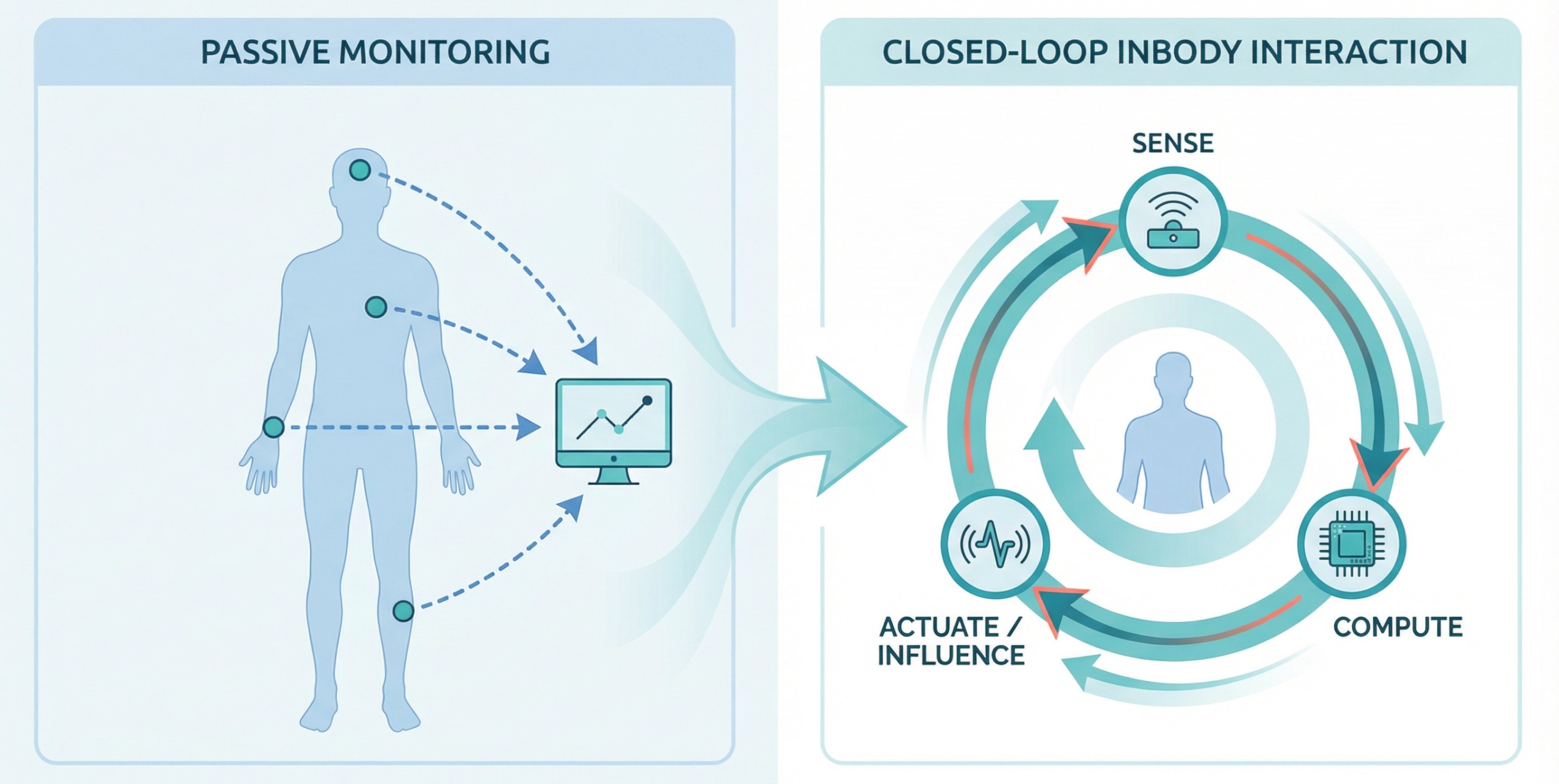
This represents a fundamental shift in human-computer interaction: from passive monitoring of physiological signals toward active, bidirectional manipulation of internal states. We can now design closed-loop systems that sense cardiac rhythms, provide interventions to influence those rhythms, and measure resulting changes in both physiological patterns and psychological states.
Research Gap and Motivation
Workshops on cognitive sensing and affective computing have addressed inference of psychological states from physiological signals, but primarily in one direction (sensing without manipulation). What remains absent is systematic investigation of bidirectional interaction with internal organ states - not external muscles or passive sensing, but closed-loop computational engagement with cardiac, respiratory, metabolic, and gastric function.
What distinguishes this workshop from traditional biofeedback is the move from passive sensing to active manipulation, from one-way monitoring to closed-loop control, and from single-modality interventions to integrated approaches engaging multiple interoceptive pathways simultaneously. Rather than merely inferring user states from bodily signals, we design interaction paradigms that bidirectionally engage with internal states.
- How do we design interaction paradigms for signals users often cannot directly perceive or voluntarily control?
- What computational frameworks enable real-time adaptation and personalization?
- How do we create feedback loops that respect user agency while effectively modulating internal states?
- What interface metaphors are appropriate for representing and manipulating interoceptive information?
Interoceptive signals from the heart, respiratory system, gut, and metabolic processes contribute to the subjective experience of affect. This suggests that systems capable of modulating these internal states might serve as tools for emotion regulation - moving beyond emotion recognition toward emotion interaction.
The timing is opportune: sensor technologies now enable non-invasive measurement of cardiac electrical activity, breathing patterns, continuous glucose levels, and gastric electrical rhythms with sufficient precision for closed-loop control. Actuation methods have expanded beyond visual feedback to include haptic cardiac biofeedback, thermal respiratory guidance, transcutaneous vagus nerve stimulation, and olfactory triggering. Machine learning approaches can personalize interventions based on individual physiological signatures.
Scope
This workshop focuses on closed-loop, bidirectional in-body interactions centered on physiological states - not external motor control and not only passive sensing for emotion recognition. Our scope encompasses cardiac, respiratory, metabolic, and gastric systems as primary interoceptive modalities. Brain stimulation is explicitly excluded; it constitutes a separate research community already well-covered in other venues.
Call for Participation
We invite submissions from researchers and practitioners spanning:
- HCI researchers exploring interaction paradigms
- Affective computing experts connecting internal states to emotion
- Biosignal processing specialists developing sensing methods
- Machine learning researchers creating adaptive algorithms
- Physiological psychologists studying interoceptive mechanisms
- Ethicists establishing appropriate boundaries
To participate in the workshop, please submit one of the following:
- Position statement up to 2 pages describing a perspective, challenge, or opportunity.
- Interactive research prototype 1-page write-up describing a demo you would like to present.
Use the following templates (submissions are not anonymous):
Submission Form
Submit your materials via the Google Form: Submission Form
Required fields:
- Author names
- File upload (PDF)
- Agreement to attend in person if the workshop is accepted
Submissions will be reviewed by the organising committee and selected for invitation based on the relevance to the workshop theme and the ability to foster discussion at the workshop.
Important Dates
- Submission deadline: 28 February 2026 (AoE)
- Decision Notifications: 1 March 2026 (AoE)
- Workshop Date: 16 March 2026
Content of Workshop
We intend to hold a half-day workshop with approximately 10 position papers and demonstrations. The workshop will consist of three components: lightning talk presentations, breakout group discussion, and synthesis of the discussion and plan beyond the workshop.
We will need a room with round tables to facilitate breakout discussions, a projector with standard AV, power outlets, flip charts, post-it notes, and whiteboard markers.
Goals and Outcomes
The goal of the workshop is to provide a platform to brainstorm, debate, and discuss closed-loop interoceptive manipulation as a coherent research area with systematic frameworks, shared methods, and ethical guidelines.
- Goal 1: Map the interaction design space for in-body interaction. Identify dimensions such as intervention modality, target organ system, temporal patterns, user awareness levels, and degree of user control.
- Goal 2: Draft an ethics charter for in-body interaction research. Examine risk scenarios, mitigation patterns, privacy, and boundaries across contexts.
- Goal 3: Specify a minimal viable manipulation toolkit. Outline a practical toolkit architecture supporting multiple modalities and closed-loop control.
- Goal 4: Establish a research agenda and foster collaborations. Identify key challenges, open questions, and opportunities for cross-institutional projects.
Proceedings will be made available via the workshop webpage. Together with interested attendees, the discussion will be extended as a journal paper.